Oscar Viking Jansson
Game & UX/UI Designer

2025

Game DesignUI ImplementationUsability TestingPrototypingUnreal Engine 5

VALIDATION NOTE

VALIDATION NOTE: Since completing this concept, Blizzard implemented their own team status HUD targeting the same coordination friction. This study reflects my original UE5 prototype and hypothesis on how to solve teammate re-engagement timing.

This case study explores how contextual UI can improve decision-making in high-speed hero shooters by visualizing teammate "readiness". Using a functional Unreal Engine 5 prototype, I designed a HUD system that tracks respawn timers and re-engagement distances to prevent mistimed fights.

By iterating from passive data to an intent-based ping system, the final design provides actionable information exactly when needed, aiming to reduce cognitive load and minimizing the potential for team toxicity.

Timeframe

3 Weeks

Goal

Create a more transparent multiplayer environment where the reasons behind a win or loss are clearly understood, reducing the frustration caused by mismanaged expectations.

Project Deep Dive

The Problem

Is it a good moment to commit?

In competitive play, split-second decisions happen fast. While current tools like friendly outlines, the killfeed, and the scoreboard provide basic awareness, they fail to communicate team readiness in terms of timing and distance.

Players often engage without knowing if optimal backup is available or hesitate when help is seconds away. These mistimed decisions lead to lost fights, frustration, and a breakdown in team coordination.

Portfolio content view

Initial Design

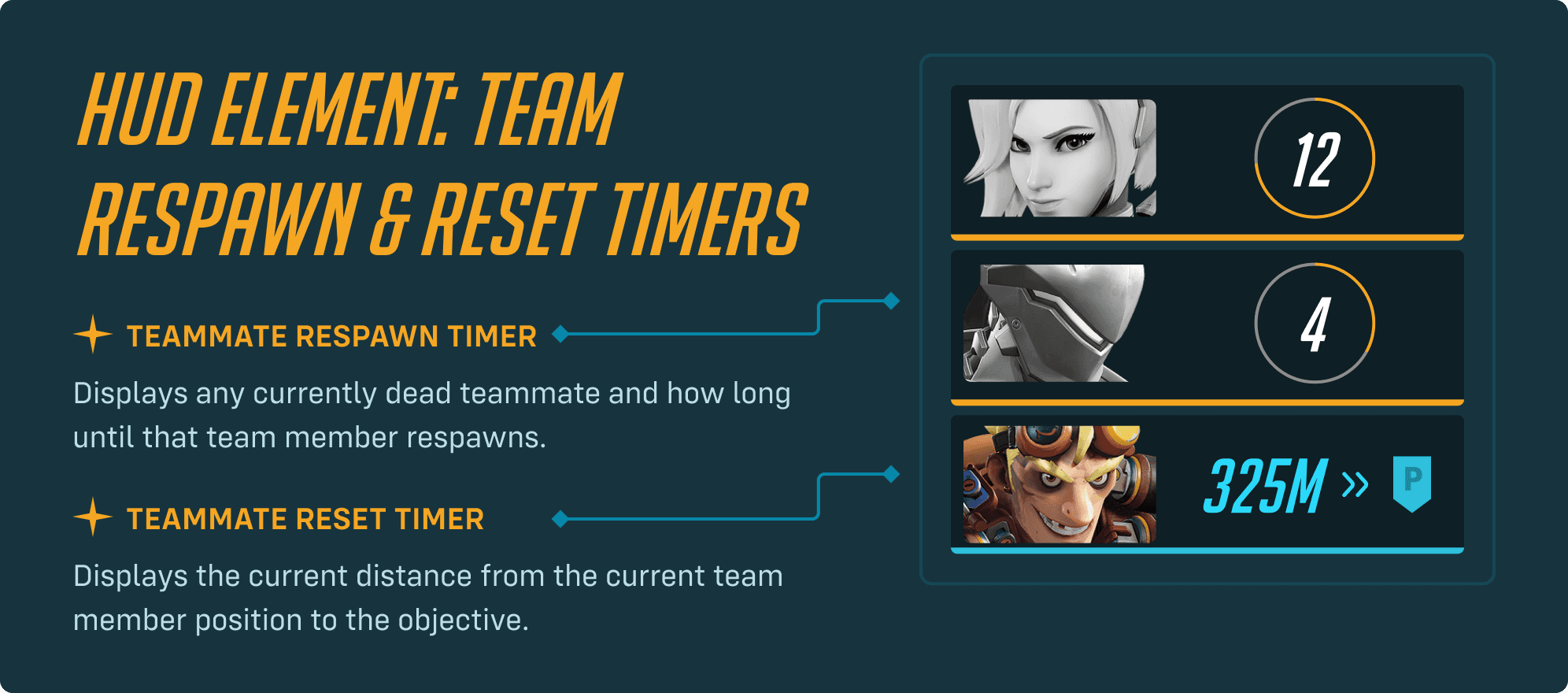
I designed a dynamic HUD element that provides actionable data regarding missing team members. It displays which hero is dead and their remaining respawn time. After they respawn, it shows the distance of the teammate relative to the objective.

Portfolio content view

Prototype

To validate the UI in a realistic context, I built a functional prototype in Unreal Engine 5.7. I implemented a fire-rate scaling mechanic where the player's weapon fire rate increases based on the number of nearby friendly NPCs. This made it difficult to secure kills alone, ensuring players had a genuine incentive to use the UI for regrouping. The system uses a central UI panel that dynamically creates, replaces, and removes widgets based on NPC states.

Portfolio content view

Testing

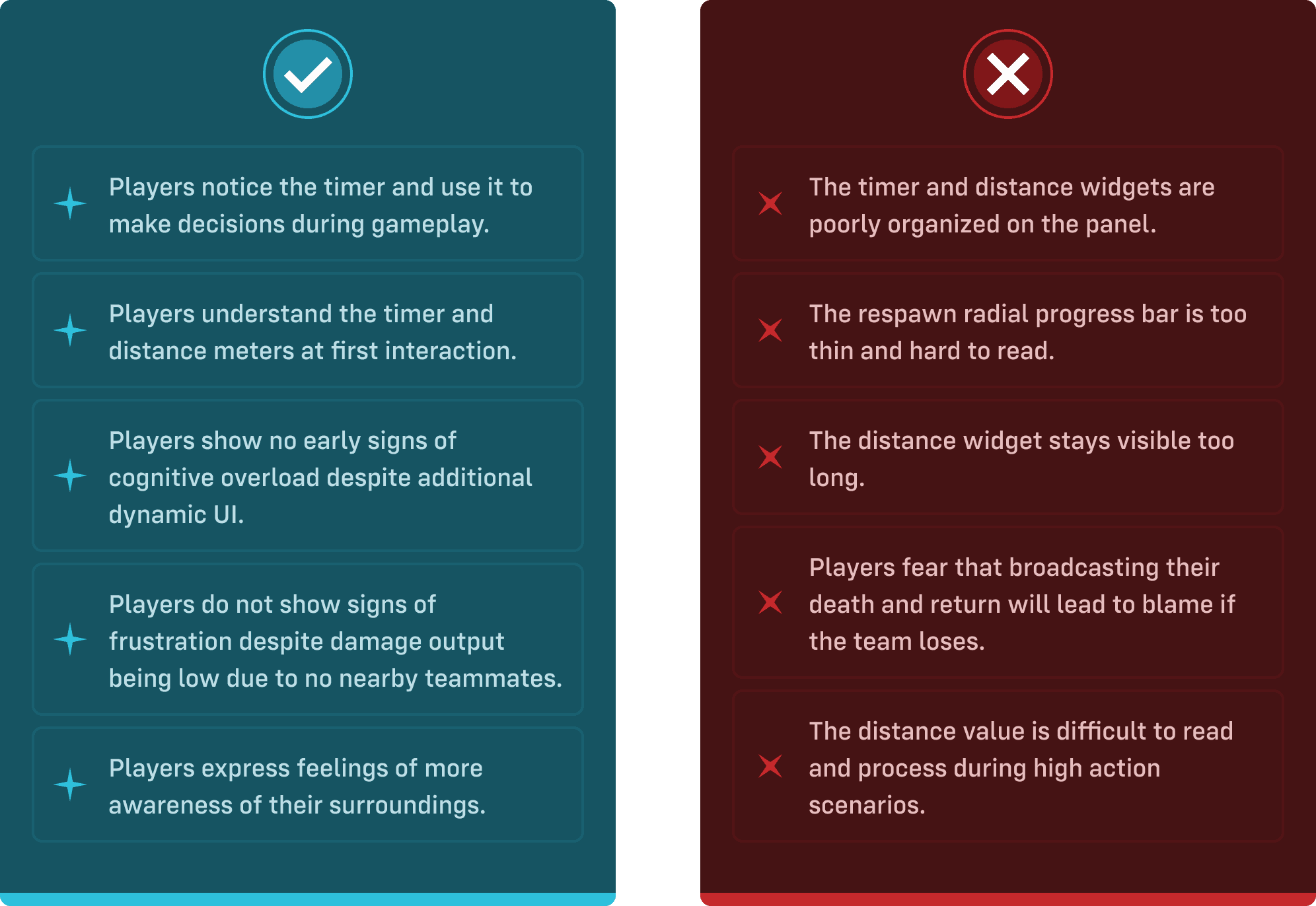
User tests with competitive players revealed critical UX challenges. Raw distance values and radial progress bars were too slow to process during high-action moments. Players also expressed a psychological concern where they feared that broadcasting their location could lead to blame or toxicity from teammates.

Portfolio content view

Iteration

The final iteration solved these issues by integrating the UI with the game’s Ping System. The distance indicator now only appears when a teammate pings the objective to signal they are "On my way". Raw meters were replaced with linear progress bars and increased line thickness to facilitate faster scanning under pressure. The UI now disappears once it is no longer relevant, keeping the HUD clean.

Portfolio content view

Test results

  • The prototype demonstrates that providing clear re-engagement data directly supports better tactical decision-making.

  • Players spend less time searching for teammates and more time focusing on combat.

  • Participants reported feeling more aware of their team's status and readiness.

Final Thoughts

Overwatch is fundamentally a game of teamplay and strategy where collaboration is the key to victory. In an environment where voice communication isn't always viable or preferred, vital information must be accessible to all in a way that encourages tactical decision-making. By visualizing teammate readiness, we empower individual players to make informed decisions faster.

However, further testing is essential to determine if these additional UI elements increase cognitive load in the high-intensity chaos of a live match, or perhaps if they inadvertently shift the focus toward player blaming rather than collaboration.

Oscar Viking Jansson

oscarvikingjansson@gmail.com

Oscar Viking Jansson

oscarvikingjansson@gmail.com